Absurdle Rules
An adversarial word guessing puzzle that delays committing to an answer and gives feedback that keeps as many solutions alive as possible.
Also known as: Adversarial Wordle
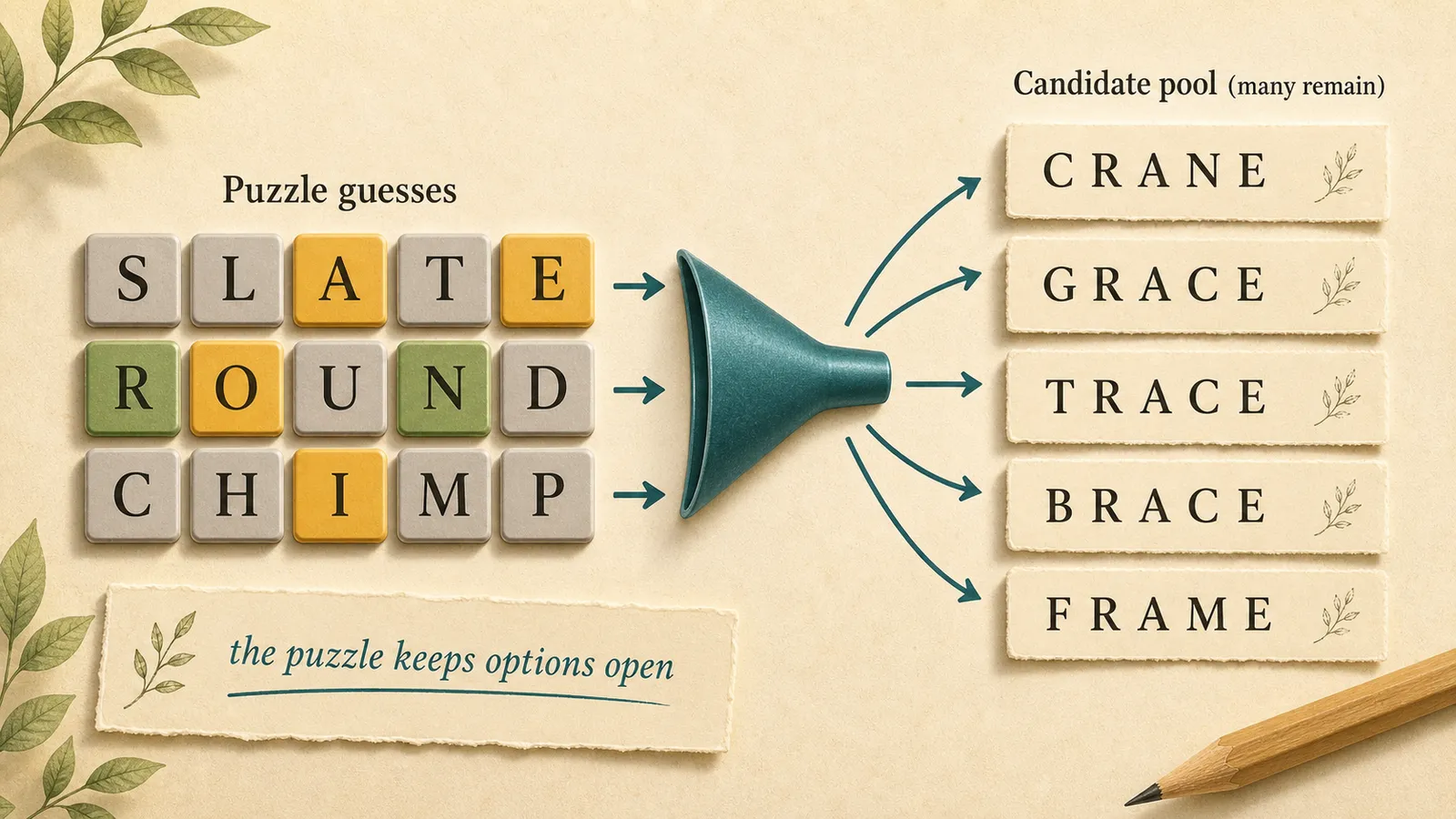
Absurdle is a lesson in information theory disguised as a word puzzle. The feedback is legal, but it is chosen to preserve ambiguity. That means a normal Wordle instinct, such as guessing the most likely answer, may be weaker than a broad partitioning guess.
Solving well means thinking about sets. Ask which guess will eliminate the most possible answers no matter what feedback appears.
Quick answer
Absurdle looks like Wordle, but the hidden word effectively resists you. Use guesses that split the candidate pool instead of chasing one likely answer too early.
Puzzle facts
| format | Adversarial word guessing puzzle |
|---|---|
| players | Solo |
| time | 5-20 minutes |
| difficulty | Hard |
What you need
- An Absurdle-style feedback grid.
- A keyboard and patience for candidate elimination.
Setup
- Start with a broad word that tests common letters.
- Read feedback as the puzzle narrowing its possible answer family.
- Choose later guesses to split remaining candidates.
Objective
Force the puzzle into a single answer by making guesses that shrink the remaining candidate set.
Rules
- Each guess must be valid.
- Feedback remains consistent with at least one possible answer.
- The puzzle may avoid committing until forced.
- You win when your guess matches the final remaining answer.
Scoring and results
- Many players measure performance by number of guesses.
- Because the puzzle is adversarial, fewer guesses require strong elimination strategy.
Examples
Original elimination idea
If `SLATE` returns little information, a second broad test like `ROUND` may be better than guessing a narrow answer family.
Forcing move
When only `CRANE` and `CRATE` remain, choose a word that distinguishes N from T if direct guessing is risky.
Strategy tips
- Think in candidate groups, not hunches.
- Use non-answer test words when they split the pool well.
- Track which feedback patterns remain possible.
- Avoid emotional guessing; the puzzle is designed to dodge you.
Common mistakes
- Playing exactly like normal Wordle.
- Assuming the answer was fixed from the first turn.
- Failing to test letters that separate close candidates.
History and background
Adversarial guessing games became popular because they reveal hidden assumptions in standard feedback puzzles. Absurdle is best understood as a rules experiment: what if the puzzle answers as unhelpfully as possible while staying honest?
This guide uses original examples and does not reproduce any official interface or answer list.
Variations
- Adversarial number guessing.
- Hard-mode adversarial word variants.
- Classroom candidate-set demonstrations.
Visual guide
Use this example to see how the puzzle works before you try the steps yourself.
FAQ
Is Absurdle cheating?
No. Its rule is that feedback stays consistent while preserving ambiguity; the adversarial behavior is the point.
Can Absurdle be solved?
Yes. Careful guesses eventually force the candidate set down.
Where to play Absurdle
App and web picksSources
Rule references and official game pages where available. App recommendations are separate from sources.
- Official game page
Official source for Absurdle play.