Minute Cryptic Rules
A bite-size cryptic clue puzzle that asks solvers to crack one clue using definition, wordplay, and clue grammar.
Also known as: Minute cryptic crossword
Minute Cryptic is useful because it isolates the part of cryptic crosswords that beginners most need to practice: reading a clue on two levels at once. A clue may sound like a normal phrase, but one part defines the answer while another part instructs you to anagram, reverse, insert, remove, or otherwise build letters.
Do not try to solve it like a trivia clue only. The answer should satisfy the surface meaning loosely, but the real test is whether the wordplay gives a fair route to the same letters. If you can explain how every piece works after solving, you have solved it cleanly.
Quick answer
Minute Cryptic compresses cryptic crossword solving into a single clue. Look for the definition at one end of the clue, identify the wordplay indicator, and verify each letter of the answer from the clue text.
Puzzle facts
| format | Daily cryptic clue puzzle |
|---|---|
| players | Solo |
| time | 1-8 minutes |
| difficulty | Medium to hard |
What you need
- One cryptic clue and answer length.
- A basic awareness of cryptic devices such as anagrams, hidden words, reversals, containers, and homophones.
- Optional scratch space for rearranging letters.
Setup
- Read the clue once for surface meaning.
- Check whether the definition is likely at the beginning or end.
- Circle possible indicator words such as oddly, broken, heard, around, or back.
- Use the enumeration to test answer length.
Objective
Solve the hidden answer by separating the clue into definition and wordplay, then confirming that every part of the clue is accounted for.
Rules
- A fair cryptic clue usually contains a definition and wordplay.
- The definition is commonly at one end of the clue.
- Indicator words signal the type of wordplay being used.
- The answer must match the enumeration.
- A complete solve should explain both meaning and construction.
Scoring and results
- Most single-clue formats are solved or unsolved rather than point-scored.
- Streaks, timers, or hints may be tracked by a particular site.
- A clean solve means you can parse the clue, not merely guess the answer.
Examples
Original clue parse
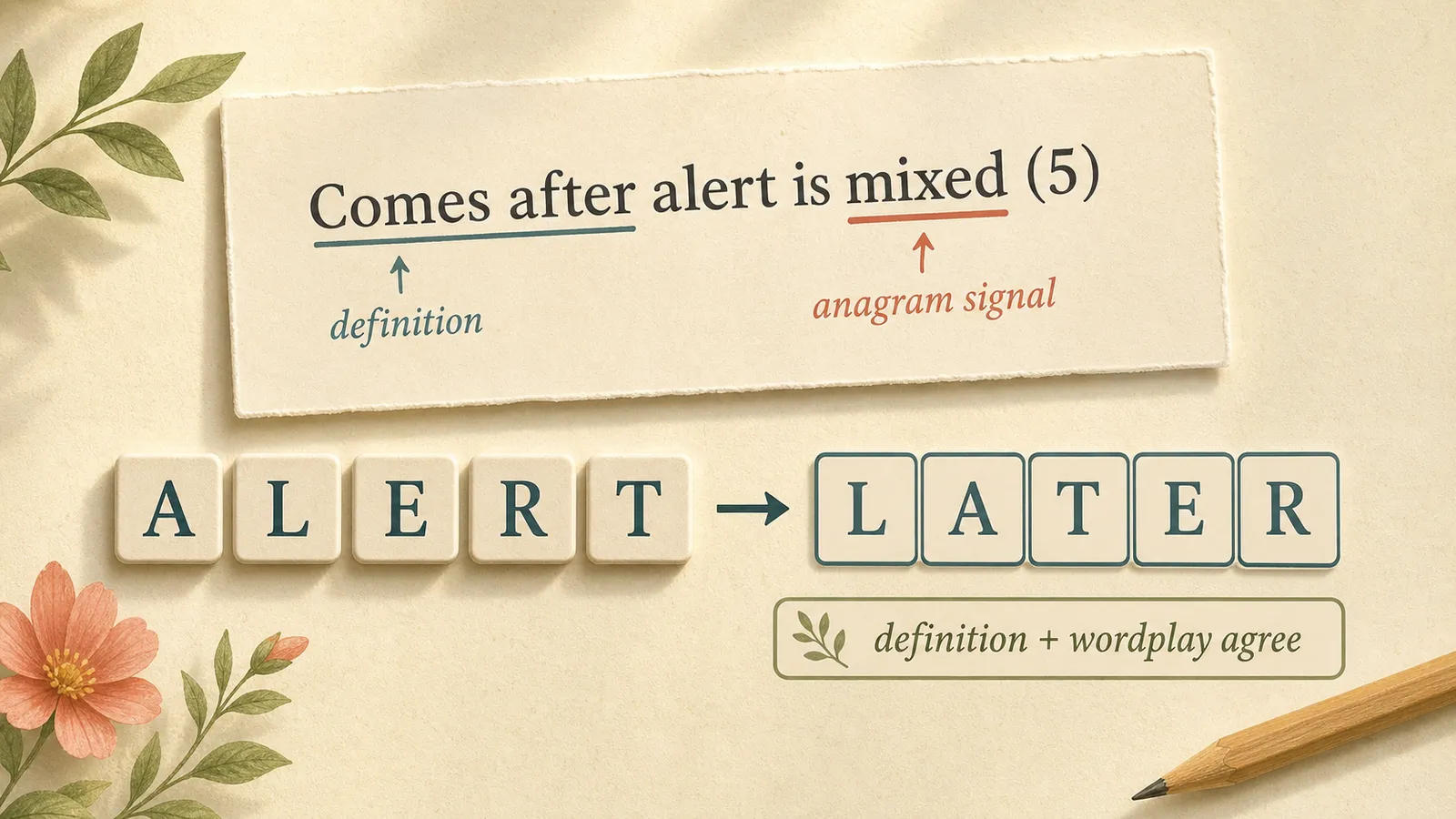
Original clue: `Comes after alert is mixed (5)`. Answer: `LATER`. Definition: `Comes after`. Wordplay: `ALERT` is mixed to make the same five letters.
Charade example
Original clue: `Opposite of yes: no plus table initially (3)`. Answer: `NOT`. Definition: `Opposite of yes`. Wordplay: `NO` plus the first letter of `table`.
Hidden answer example
Original clue: `Small stream in amber brooklet (5)`. Answer: `BROOK`, hidden directly inside `amber brooklet`. Always verify the exact letter sequence.
Strategy tips
- Assume the definition is at one end until proven otherwise.
- Learn indicator words by type rather than memorizing full clues.
- Write down candidate answer lengths before committing.
- After a guess, force yourself to parse every letter.
- Use failed parses as learning; they reveal which clue device you missed.
Common mistakes
- Guessing from the surface reading alone.
- Ignoring enumeration.
- Accepting an answer when one or two letters are unexplained.
- Mistaking a definition word for an indicator without evidence.
History and background
Minute-style cryptic puzzles reflect a broader trend toward small daily challenges that teach one idea at a time. They lower the barrier to cryptic crosswords because solvers can focus on a single clue instead of a full grid.
This page avoids reproducing real daily clues. The examples are original teaching snippets designed to explain clue parsing rather than mirror any publisher puzzle.
Variations
- One-clue daily cryptics.
- Mini cryptic crosswords with a small grid.
- Training puzzles grouped by clue device.
Visual guide
Use this example to see how the puzzle works before you try the steps yourself.
FAQ
What makes a clue cryptic?
A cryptic clue normally gives the answer twice: once by definition and once through wordplay.
Where is the definition in a cryptic clue?
Usually at the start or end, though advanced clues can be trickier.
Should every letter be explained?
Yes. A strong cryptic solve accounts for the whole answer.
Where to play Minute Cryptic
App and web picksSources
Rule references and official game pages where available. App recommendations are separate from sources.
- Official game page
Official source to verify current Minute Cryptic format.