Phoodle Rules
A food-themed daily word guessing game where the answer comes from cooking, ingredients, restaurants, or food culture.
Also known as: Food Wordle
The main difference between Phoodle and a general word guesser is the answer universe. You are not just solving a letter pattern; you are solving a food clue space. Once feedback narrows the letters, ask what edible, culinary, or restaurant-related words fit.
Good Phoodle solving mixes normal deduction with category awareness. A strange-looking pattern may become obvious if you think of spices, sauces, utensils, or preparation methods.
Quick answer
Phoodle uses a food vocabulary twist on word guessing. Start with useful letters, then switch your candidate list toward ingredients, dishes, cooking verbs, and kitchen terms.
Puzzle facts
| format | Daily food-themed word puzzle |
|---|---|
| players | Solo |
| time | 3-8 minutes |
| difficulty | Easy to medium |
What you need
- A daily food-word puzzle.
- Keyboard input.
- Basic food vocabulary.
Setup
- Enter a broad starter word with common letters.
- Read the feedback as letter constraints.
- Filter candidates to food-related terms.
Objective
Guess the hidden food-related word using limited attempts and color-style feedback.
Rules
- Guess a valid word accepted by the puzzle.
- Use feedback to place correct letters and move misplaced letters.
- Keep the theme in mind when choosing later guesses.
- Solve before the guess limit runs out.
Scoring and results
- Most results show number of guesses used.
- Streaks may matter in daily formats.
Examples
Original food example
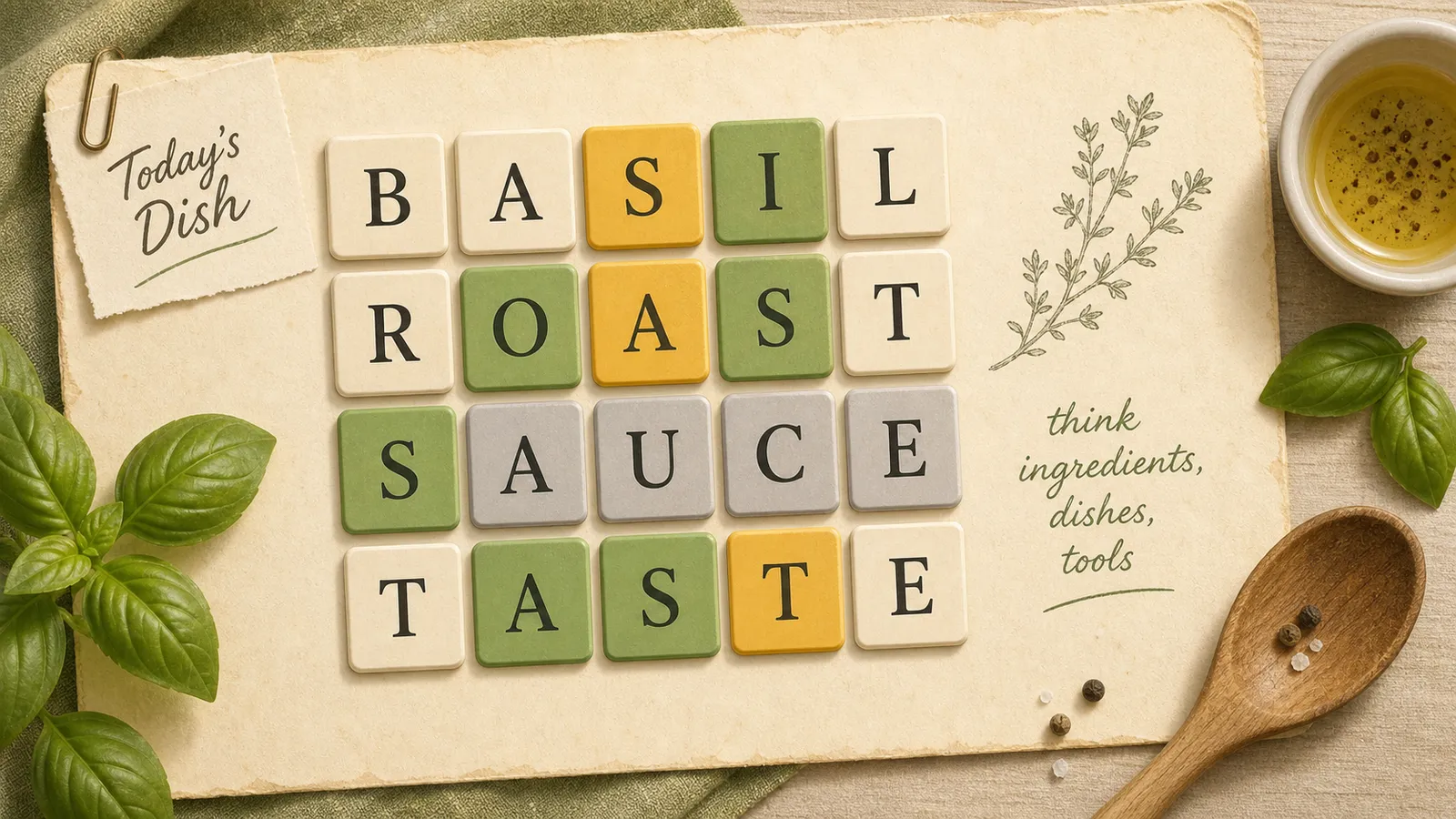
If `BASIL` gives strong feedback on `A` and `S`, later guesses might test `SAUCE`, `ROAST`, or `SALTY` depending on positions.
Theme filter
A pattern like `_ R A I N` may be less likely than a kitchen word that fits the same letters.
Strategy tips
- After two guesses, list only food-adjacent candidates.
- Test vowels early because many food words are vowel-heavy.
- Remember cooking verbs such as roast, mince, knead, and braise.
- Do not forget utensils, cuisines, and flavor words.
Common mistakes
- Using general Wordle answer habits when the theme points elsewhere.
- Forgetting repeated letters in words like cocoa or puree.
- Guessing obscure food terms before testing common letters.
History and background
Food-themed guessing games became popular as daily word puzzles branched into niche vocabularies. The category gives solvers a helpful constraint and a more playful personality than a generic word list.
This guide uses original food examples only and does not reproduce any daily answer or branded interface.
Variations
- Cuisine-specific word guessing.
- Recipe clue variants.
- Food trivia plus letter feedback hybrids.
Visual guide
Use this example to see how the puzzle works before you try the steps yourself.
FAQ
Do I need to be a chef?
No. Most solves rely on familiar food vocabulary plus letter logic.
Are answers always ingredients?
No. They may include dishes, tools, cooking words, or food culture terms.
Where to play Phoodle
App and web picks- Word Cash: A Collection of Word PuzzlesMade by us
Sources
Rule references and official game pages where available. App recommendations are separate from sources.
- TODO official source
Add official source URL after verification.