Wordament Rules
A competitive word-finding game where players trace as many words as possible on the same letter grid during a timed round.
Also known as: Microsoft Wordament
Wordament feels like a digital cousin of Boggle, with the added pressure of live or leaderboard competition. Everyone may see the same grid, so the edge comes from scanning speed, vocabulary, and quickly spotting productive letter clusters.
The best players do not wander randomly. They mine common prefixes, suffixes, and high-value corners, then reset their eyes before the timer panic sets in.
Quick answer
Wordament is about speed plus path quality. Trace adjacent letters to make words, prioritize longer and rarer finds, and keep moving when a corner of the board goes cold.
Puzzle facts
| format | Competitive letter-grid word game |
|---|---|
| players | Solo or multiplayer |
| time | 2-3 minute rounds |
| difficulty | Medium |
What you need
- A Wordament-style letter grid.
- Timer.
- Touch or mouse input for tracing paths.
Setup
- Wait for the round grid to appear.
- Scan for common starts such as ST, RE, IN, and TH.
- Trace valid adjacent paths quickly.
Objective
Find high-value valid words on the grid before time expires and outscore other players or your own previous result.
Rules
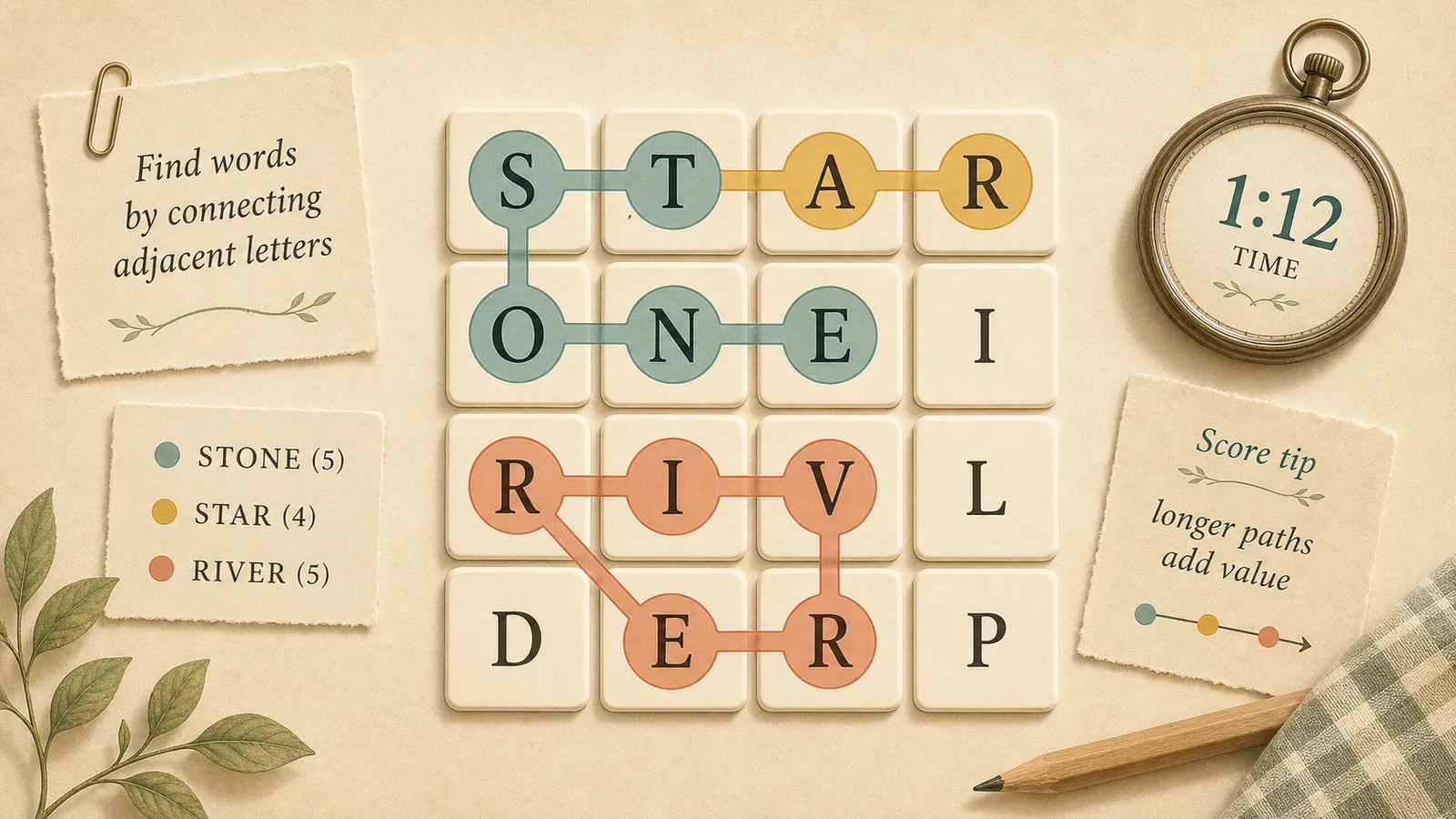
- Words are formed by connecting adjacent letters.
- A tile generally cannot be reused within one word path.
- Words must be accepted by the game dictionary.
- The round ends when the timer expires.
Scoring and results
- Longer words usually score more.
- Rare letters or board bonuses may affect scoring depending on mode.
- Rankings compare your total with other players or leaderboard entries.
Examples
Original grid path
A path `S` -> `T` -> `O` -> `N` -> `E` scores a clear five-letter word if the letters touch.
Cluster mining
From `RE`, look fast for `READ`, `REAL`, `RENT`, or `REST` if neighboring letters allow them.
Timer choice
A certain four-letter word is usually better than spending fifteen seconds hunting one unlikely seven-letter word.
Strategy tips
- Start with common two-letter clusters and expand.
- Sweep the board in quadrants.
- Prioritize longer words only when the path is clear.
- Practice endings such as -ING, -ED, -ER, and -LY.
- Move on quickly after a rejected word.
Common mistakes
- Reusing a tile in one word.
- Spending too long on one promising cluster.
- Ignoring short words that build score quickly.
- Panicking and tracing invalid jumps.
History and background
Wordament helped popularize always-on competitive word grids in digital form. Its appeal is the combination of familiar adjacent-letter word finding and quick leaderboard feedback.
This guide is independent from Microsoft and uses original examples only, with no screenshots or branded interface elements.
Variations
- Solo practice.
- Daily challenge boards.
- Theme or bonus rounds.
Visual guide
Use this example to see how the puzzle works before you try the steps yourself.
FAQ
Is Wordament like Boggle?
Yes, it shares adjacent-letter word finding, but digital scoring and multiplayer leaderboards change the pace.
Can I reuse a tile?
Usually not within the same word path.
What matters more, speed or word length?
Both. Short words keep points flowing, while longer words create score jumps.
Where to play Wordament
App and web picksSources
Rule references and official game pages where available. App recommendations are separate from sources.
- Official Microsoft Store page
Official listing for Wordament.