Crosswordle Rules
A Wordle-inspired logic puzzle where players work backward from a solved row and construct earlier guesses that fit the feedback.
Also known as: Cross Wordle
Crosswordle flips the usual word guessing rhythm. Instead of asking what hidden word matches your feedback, it gives you the destination and asks whether you understand the feedback rules well enough to reconstruct a legal route.
That makes it a useful teaching puzzle for repeated letters, gray constraints, and positional logic. If a row seems impossible, the problem is usually not vocabulary but a contradiction in the colors.
Quick answer
Crosswordle is less about finding the answer and more about making a consistent path to it. Each earlier row must be a valid word and must produce the displayed feedback against the final answer.
Puzzle facts
| format | Reverse word deduction puzzle |
|---|---|
| players | Solo |
| time | 4-10 minutes |
| difficulty | Medium |
What you need
- A Crosswordle-style grid.
- Valid word knowledge.
- Careful attention to color-feedback rules.
Setup
- Read the final answer row.
- Study the required feedback pattern for each earlier row.
- Choose valid words that produce exactly those colors.
Objective
Fill a grid with valid prior guesses that could logically lead to the known answer and color pattern.
Rules
- Each row must be a valid word.
- Feedback must be consistent with the final answer.
- Green letters must match exact positions.
- Yellow letters must appear in the answer but not in that row position.
- Gray letters must not exceed the answer’s letter counts.
Scoring and results
- Completion is usually binary: the constructed grid works or it does not.
- Some versions track time or streaks.
Examples
Original reverse example
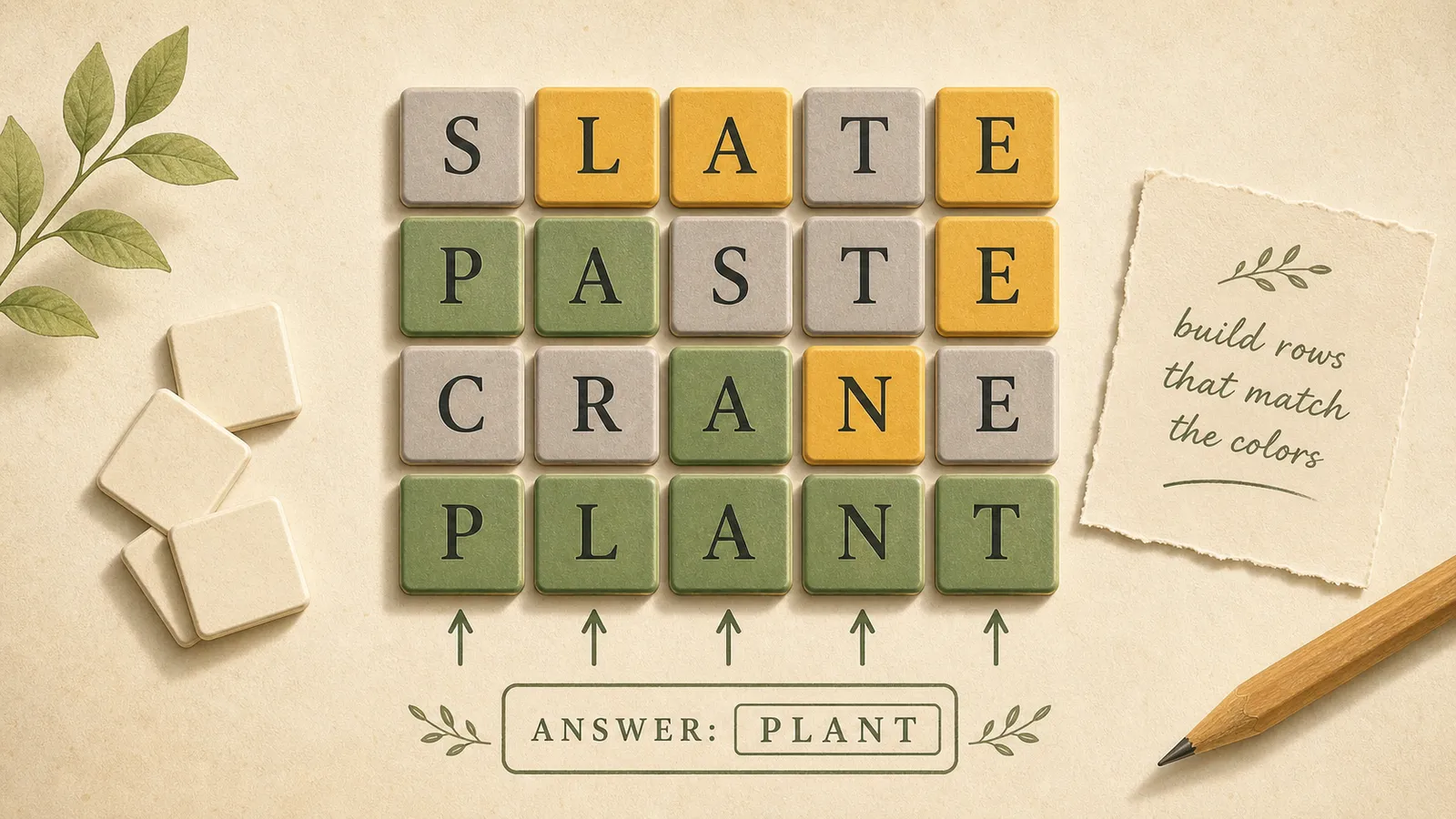
If final answer is `PLANT`, an earlier row `PASTE` can only be used if its feedback matches P in position and treats A correctly.
Repeated-letter check
A row with two `L`s cannot show both as present if the answer has only one `L`.
Strategy tips
- Start with rows that contain greens because they are most constrained.
- Handle repeated letters before searching for fancy words.
- Use gray letters to prove what cannot appear.
- Work one row at a time and test against the final answer.
Common mistakes
- Forgetting that feedback is judged against the final answer, not against neighboring rows.
- Using a word that fits the letters but not the colors.
- Overlooking letter-count limits.
History and background
Reverse feedback puzzles appeared as a natural variation once players became comfortable with Wordle-style colors. They reward understanding the system rather than only guessing the hidden word.
All examples here are original and do not copy a puzzle archive.
Variations
- Larger reverse grids.
- Hard-mode reconstruction.
- Classroom feedback-rule exercises.
Visual guide
Use this example to see how the puzzle works before you try the steps yourself.
FAQ
Is Crosswordle a crossword?
Despite the name, it is usually a word-feedback logic puzzle rather than a clue crossword.
Why is it harder than Wordle?
You must satisfy several feedback rows exactly, so contradictions matter more.
Where to play Crosswordle
App and web picks- Word Cash: A Collection of Word PuzzlesMade by us
Sources
Rule references and official game pages where available. App recommendations are separate from sources.
- TODO official source
Add official source URL after verification.