Phrazle Rules
A phrase-guessing puzzle where each attempt gives letter feedback across multiple words instead of a single five-letter answer.
Also known as: Phrase Wordle
Phrazle expands the familiar color-feedback idea from one word to a whole phrase. That makes each guess more informative, but also more fragile: a letter can be right in one word, misplaced within the phrase, or simply not useful for the expression you are trying to uncover.
Beginners should pay attention to phrase rhythm. Articles, prepositions, and short connector words often reveal the structure before the main nouns or verbs are solved.
Quick answer
Phrazle plays like a phrase-sized word deduction puzzle: guess a complete phrase of the right shape, read the feedback by letter, then use both word patterns and common expressions to narrow the answer.
Puzzle facts
| format | Daily phrase guessing puzzle |
|---|---|
| players | Solo |
| time | 4-12 minutes |
| difficulty | Medium |
What you need
- A Phrazle-style phrase grid.
- A keyboard for entering full-phrase guesses.
- Awareness of the answer word lengths shown by the puzzle.
Setup
- Read the phrase shape before guessing.
- Start with a common phrase that matches the word lengths.
- Use feedback to lock letters and eliminate impossible expressions.
Objective
Identify the hidden phrase by using letter-position feedback, word lengths, and phrase logic across several guesses.
Rules
- Each guess must match the phrase structure required by the puzzle.
- Feedback applies to letters across the phrase according to the puzzle rules.
- Correct-position letters should stay fixed in later guesses.
- Misplaced letters must move to another valid position.
- The puzzle ends when the phrase is found or guesses run out.
Scoring and results
- The result is usually based on solving within the guess limit.
- Fewer guesses indicate stronger phrase deduction.
- Some versions track streaks or completion time.
Examples
Original phrase shape
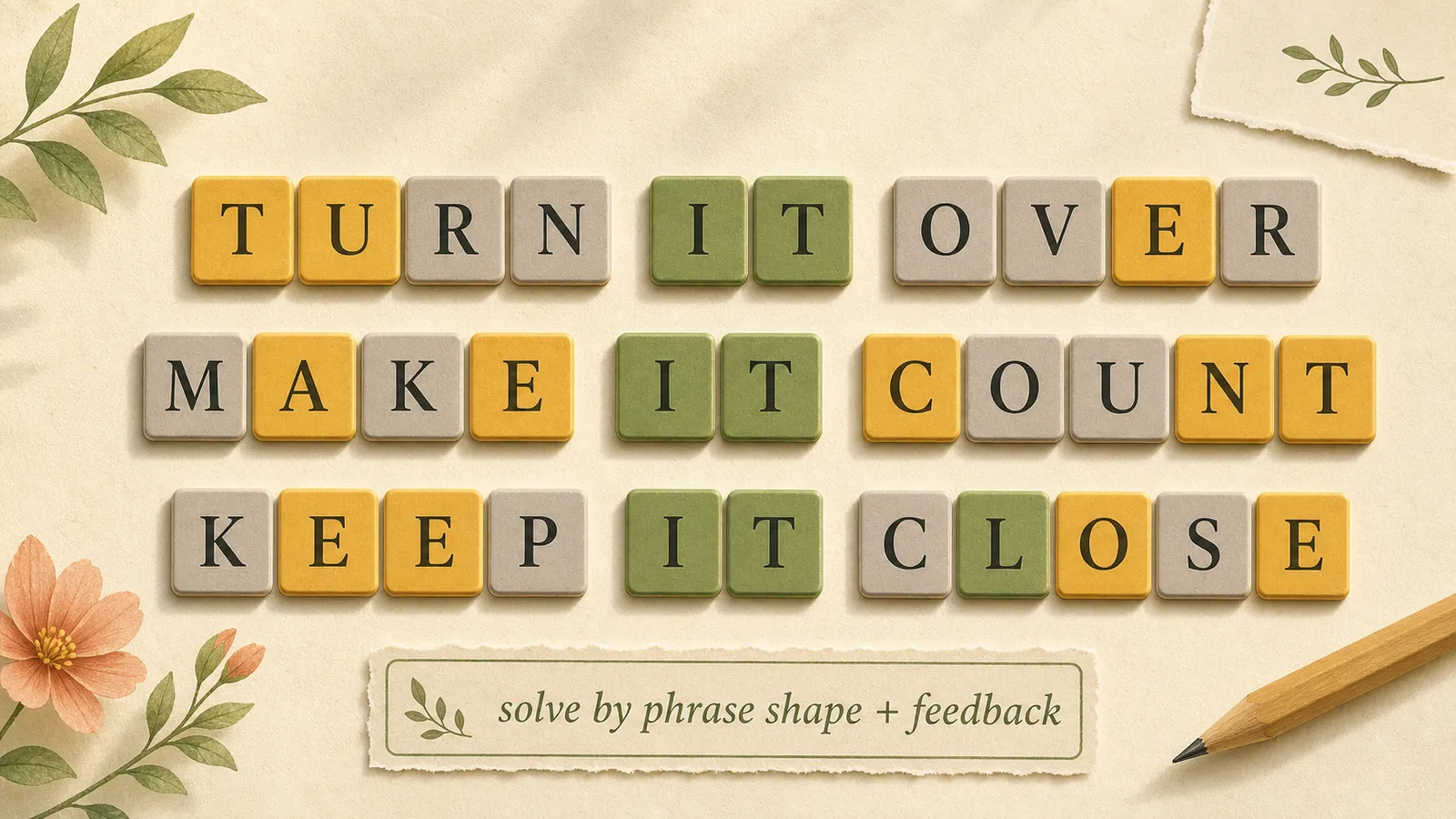
If the answer shape is `4 2 4`, an original candidate like `TURN IT OVER` tests common letters and a short connector word.
Connector clue
If the middle word locks as `IN`, search phrases that naturally use that connector before guessing random nouns.
Strategy tips
- Use common short words to anchor the phrase.
- Think in idioms and collocations, not just individual words.
- Do not over-trust a strong-looking word if it makes the whole phrase unnatural.
- Track repeated letters separately across word boundaries.
Common mistakes
- Guessing valid words that do not form a natural phrase.
- Moving a correct letter out of position.
- Ignoring the short words because they seem less important.
History and background
Phrase deduction games grew naturally from single-word feedback puzzles, adding expression knowledge and grammar to the familiar grid. Their educational value is in showing how vocabulary works in chunks, not only as isolated words.
The example phrases here are original and generic. They are not copied from any daily puzzle archive.
Variations
- Idiom-only phrase puzzles.
- Longer quote-style phrase guessing.
- Untimed practice phrase grids.
Visual guide
Use this example to see how the puzzle works before you try the steps yourself.
FAQ
Is Phrazle only about spelling?
No. Phrase sense and common wording matter as much as letter feedback.
Do spaces matter?
Yes. Word lengths and spaces shape the solution.
Where to play Phrazle
App and web picks- Word Cash: A Collection of Word PuzzlesMade by us
Sources
Rule references and official game pages where available. App recommendations are separate from sources.
- TODO official source
Add official source URL after verification.